
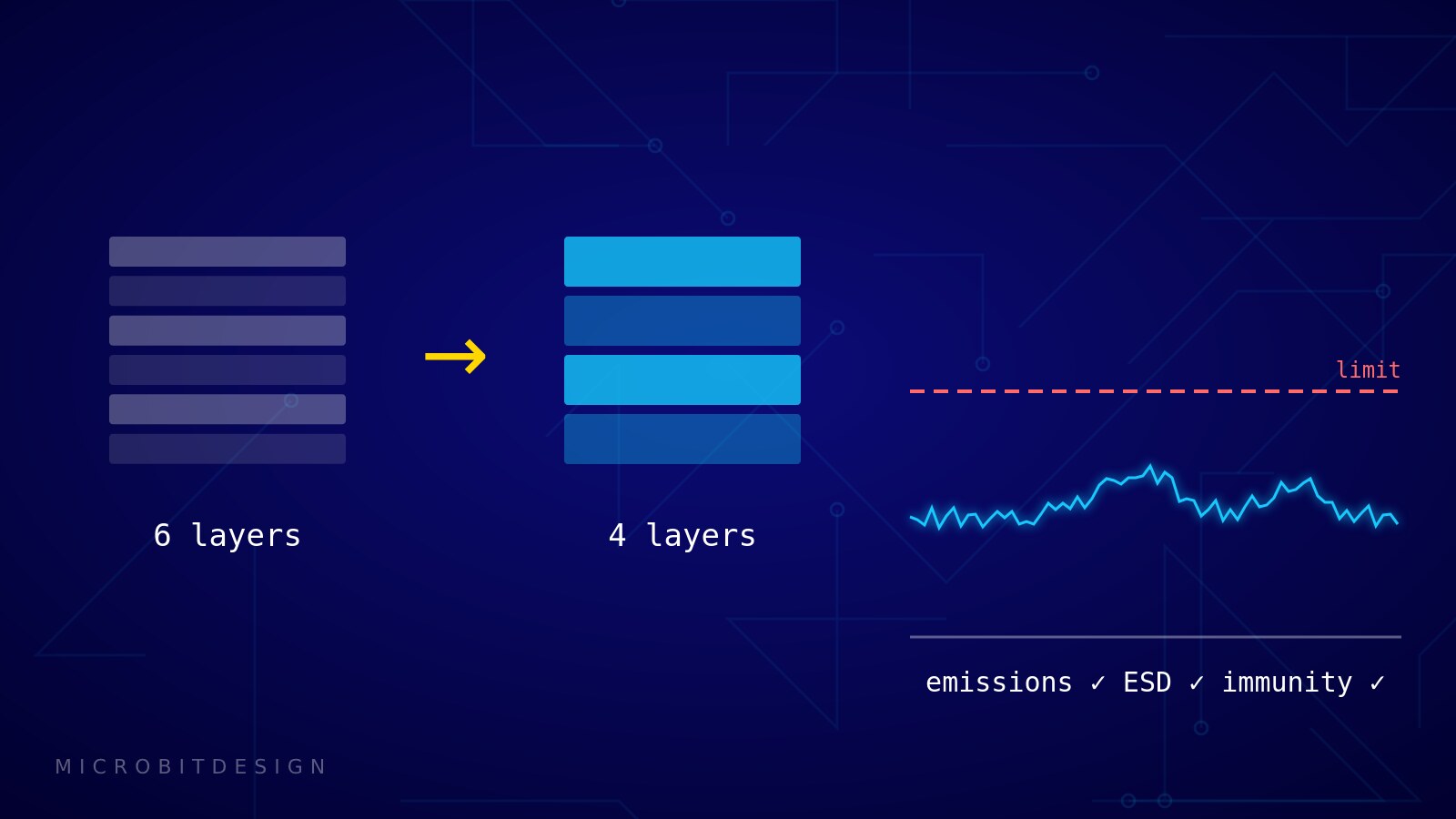
We redesigned both PCBs of a medical device: improved EMC for certification, components chosen for long-term availability, six layers reduced to four, and every EMC test passed.
A medical device manufacturer came to us with an existing product that needed a hardware redesign. The goals were clear:
- Better EMC performance, to make certification smoother and more predictable,
- Stability of supply: replacing components with poor or uncertain availability,
- Lower cost, by reducing both PCBs from six layers to four.
All of this without compromising the reliability expected from a medical device.
Why medical devices raise the bar
Medical electrical equipment has to work safely next to other equipment and must not disturb it: in hospitals, clinics and homes, surrounded by phones, radios and other devices. EMC isn't just a box to tick for market access. Each test failure means another redesign loop, more lab time and a later launch.
Medical products also have long lifetimes. A device may be manufactured for many years, and every component change after certification creates extra work. That's why supply stability is a design requirement, not a purchasing detail.
Designing for supply stability
Part of the redesign was moving away from components with long lead times, allocation risk or an uncertain future. When we choose replacements, we look at:
- availability and lifecycle status from manufacturers and distributors,
- parts that are widely stocked rather than tied to a single source, where possible,
- footprint and design choices that leave room for alternatives later,
- the effect of every change on EMC, performance and the certification path.
Designing for EMC, in four layers instead of six
Fewer layers make EMC harder: fewer solid reference planes, more routing on the outer layers, power sharing space with signals, and less room to separate noisy circuitry from sensitive circuitry. We treated EMC as a requirement from the first day of the redesign. The levers that matter most:
Stackup and reference planes
Critical signal layers get an unbroken, closely coupled reference plane, with no splits or slots under fast signals.
Return paths and layer changes
Every fast signal needs a short, predictable return path, including where it changes layers.
Partitioning and placement
Switching regulators, clocks and fast interfaces placed to keep current loops small and away from connectors and sensitive analog circuitry.
Interfaces and connectors
Filtering and protection where cables enter and leave the board keep noise from getting out, and ESD and disturbances from getting in.
Result
At an accredited EMC laboratory, the redesigned device went through radiated and conducted emissions, ESD and immunity testing:
- emissions well below the applicable limits,
- ESD and immunity testing passed smoothly,
- a four-layer design that is cheaper to manufacture,
- a bill of materials built for long-term availability.
Read more about how we approach EMC.
Technologies & disciplines
- Hardware redesign for medical electrical equipment
- Design for EMC: emissions, ESD and immunity
- Component selection for lifecycle and supply-chain resilience
- PCB stackup design and layer-count reduction
- Certification test preparation and support