
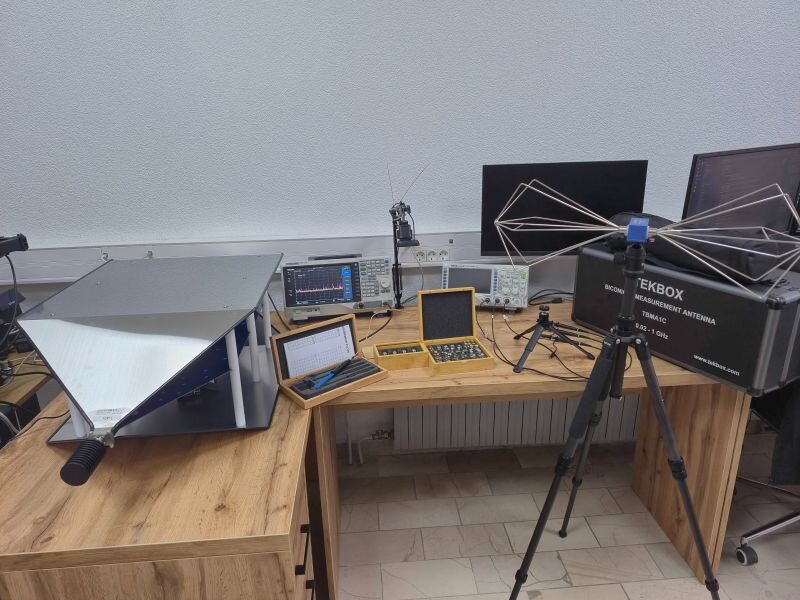
EMC is the part of hardware development that most often turns a "finished" product into another redesign. A failed test at an accredited lab means new PCBs, more lab time and a delayed launch. That's why we've been steadily expanding our own EMC measurement capabilities at MicroBitDesign.
What in-house pre-compliance is for
Let's be clear about the limits first. Our setup doesn't replace measurements in an accredited EMC laboratory, and it can't reliably predict whether a product will pass official testing. That's not the goal.
What it gives us is:
- Visibility during development. We can see how a design behaves and spot potential emission problems early.
- Relative comparisons. We can measure how a specific change, such as filtering, grounding, shielding, layout or cable routing, affects emissions compared to the previous version.
- Faster fixes after a lab test. If an issue shows up in the chamber, we can reproduce and investigate it back at our office, try different solutions and evaluate improvements before going back for another test.
We're also comparing our in-house results with real chamber measurements, to better understand where our setup is reliable and where it isn't.
Designing for EMC from the start
Measurement is only half the story. Most EMC problems are cheapest to solve at the schematic and layout stage:
- a stackup with solid reference planes and short return paths,
- filtering and protection where cables enter and leave the board,
- controlled edge rates on fast signals,
- careful placement of switching regulators and their loops.
Case in point: from six layers to four, and passing
On one recent project, I joined when the hardware needed a redesign. I reworked both PCBs and, in the process, reduced them from six layers to four, a significant cost saving, but also one that makes EMC performance harder to achieve.
At the EMC lab in Ankara we ran radiated and conducted emissions, ESD and immunity tests. After all the work that went into the redesign, it was great to see the emission measurements staying well below the applicable limits, and the ESD and immunity testing going smoothly too.
The goal
Better insight during development, fewer surprises during compliance testing, and a more efficient path to a finished product. If you're preparing a product for CE marking and want to reduce the risk of a failed EMC test, get in touch.