
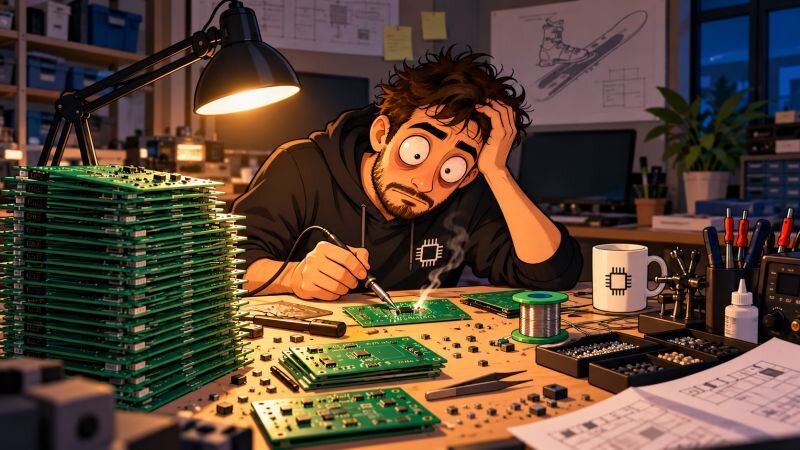
After manually assembling 42 PCBs in one week, I decided that doing it the same way next time wasn't an option. 😅
How we used to build prototypes
At MicroBitDesign we have always assembled and tested the first prototypes for our clients ourselves. Usually that meant 3–5 units: a couple stay with us for development and testing, and the rest go to the client.
For those quantities, manual assembly worked well. We use our own inventory tool to keep track of every component, and the interactive BOM plugin for KiCad to guide placement part by part.
The project that changed my mind
For an electrically assisted ski project, I needed to build 14 complete sets, each with 3 PCBs, plus all the wiring. The schedule was tight and outsourcing the assembly wasn't an option.
So I spent pretty much the whole week assembling boards. After hours of manually placing and soldering 0402 components, my back was killing me, my eyes were giving up, and I decided: I'm not doing this again. 😂
Our new setup
I started looking for a better solution and we invested in:
- a desktop pick-and-place machine, with OpenPnP support as an important part of the decision,
- a stencil printer for consistent solder paste,
- a reflow oven.
We now keep feeders loaded with the standard resistors, capacitors, inductors and LEDs we use regularly. On many of our designs, these common parts already cover a large share of the BOM.
A hybrid workflow
For just a few prototypes it still doesn't make sense to spend hours programming every single component into the machine. So we let the machine handle the repetitive small passives and place larger or unusual parts by hand before reflow.
When we need 10, 20 or more boards, we go a step further and automate much more of the assembly.
What it means for our clients
- Faster turnaround for prototypes, small test batches and hardware revisions.
- More repeatable quality than hand-placing hundreds of tiny parts.
- No dependency on an external assembly schedule every time a design changes.
The goal isn't mass production. The goal is to make prototyping faster and more repeatable, while spending less time hunched over a microscope breathing solder fumes.
Sometimes investing in automation isn't about producing more. Sometimes it's simply about working smarter, and saving your back and eyes in the process. 😄